Higher classroom screen use linked to lower pupil outcomes – new research
31 Mar 2026
New evidence suggests that it is not just phone use and extended time on social media that may be negatively impacting children's well-being but that higher levels of screen use in the classroom may also be undermining children’s learning and development.
Recent analysis presented to the US Senate by neuroscientist and educator Dr Jared Cooney Horvath draws on large-scale international studies, including PISA, TIMSS and PIRLS. Across these datasets, a consistent pattern emerges whereby higher levels of classroom screen use are associated with lower outcomes in reading, mathematics and science.
His evidence outlined how increased use of digital devices may be hindering learning. Studies indicate that students tend to understand and retain complex information more effectively when reading on paper rather than on screens, and that handwriting supports deeper learning more effectively than typing.
The reasons why
The reasons lie in how children learn. Sustained attention, deep thinking and memory formation are all supported by focused, uninterrupted engagement. By contrast, digital environments, designed around speed, novelty and task-switching, can fragment attention and reduce depth of understanding.
How best to support learning
At the same time, new research from the University of Winchester, led by Professor Bill Lucas and Dr Ellen Spencer, highlights the kinds of approaches that most effectively support both academic progress and wellbeing. Their study identifies four key elements: experiential learning, interdisciplinary learning, play, and creativity.
These approaches are strongly linked to improved engagement, deeper understanding, and the development of essential capabilities such as problem-solving, collaboration and adaptability. Crucially, the research challenges the idea that there is a trade-off between knowledge and skills, showing instead that they develop most powerfully together.
Together, these findings suggest that what matters most in education is the quality of the learning experience of which technology should be a carefully curated part, not the driver.
What happens in a Waldorf school
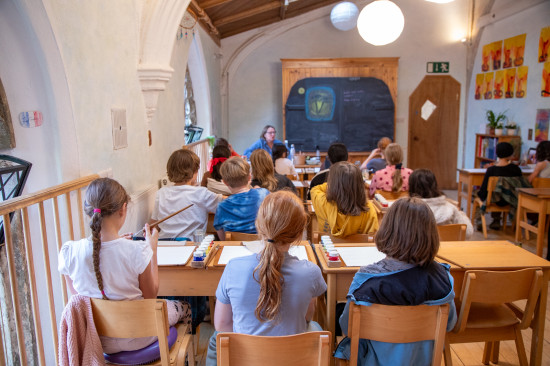
Steiner Waldorf education offers a long-established example of this approach in practice. In Waldorf schools, children are not introduced to screens in the classroom until secondary education. Instead, the early and primary years focus on hands-on, creative and experiential learning, with a strong emphasis on attention, imagination and real-world understanding. This developmental approach enables children to build the foundations they need - concentration, problem solving, creativity and confidence - before engaging with digital technology. When such technology is introduced later, it is used more consciously and effectively, as a tool rather than a driver of behaviour.
Real-world first – digital tools later
As education systems respond to rapid technological change, including the rise of artificial intelligence, these findings carry increasing weight. Preparing young people for the future depends not simply on technological knowledge, but on developing the human capacities that enable them to use it well.
The emerging evidence points towards the need for a balanced approach: real-world learning first, digital tools later - when children have the necessary maturity and skills to be in control of the technology and not the other way around.
You can watch Dr Horvath's presentation on the following link YouTube and read his written testimony to the US Senate Committee on Commerce, Science, and Transportation (26 January 2026) here.