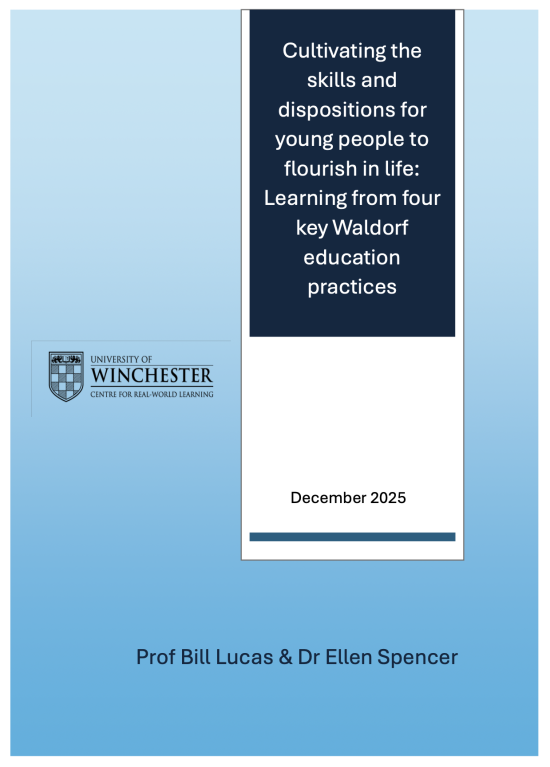
New research from the University of Winchester backs Waldorf education
12 Jan 2026
A key study led by Professor Bill Lucas, Director of the Centre for Real-World Learning at the University of Winchester and advisor to the OECD, the study shows that hands-on, discovery-based, real-world learning — including project work, play, and creative activities of the kind delivered in Steiner Waldorf schools — improves pupil engagement, wellbeing, motivation and attainment at a time when schools face rising absenteeism, mental health pressures, and growing SEND. These opportunities also strengthen problem-solving, collaboration, and creative thinking vital in preparing young people to thrive in an AI-driven world where “knowledge” is available at the press of a button.
Published as the Government reviews the national curriculum following the Curriculum and Assessment Review by Professor Becky Francis, the report challenges the idea that schools must choose between knowledge and skills, arguing instead that children need both to thrive.
Steiner Waldorf schools are highlighted as strong examples of how these evidence-based practices can be embedded across the whole curriculum.
Professor Lucas said - “Creative education is particularly important. In an AI world, the expression of human creativity and intelligence is essential – but it needs to be embedded, not treated as an ‘extra’. England is currently an international outlier in not integrating creativity more explicitly into school. Waldorf education shows how this can be achieved.”
The research was commissioned by Waldorf UK as part of a programme of evidence-based research for Waldorf teaching practices and as a contribution to the wider debate in education.